How Agentic AI Is Reshaping the Way Programmatic Campaigns Run

Since programmatic advertising emerged in the mid-1990s, the industry has steadily moved toward greater automation, from the first ad servers that replaced manual placements, to the real-time bidding systems that now execute billions of auctions every day.
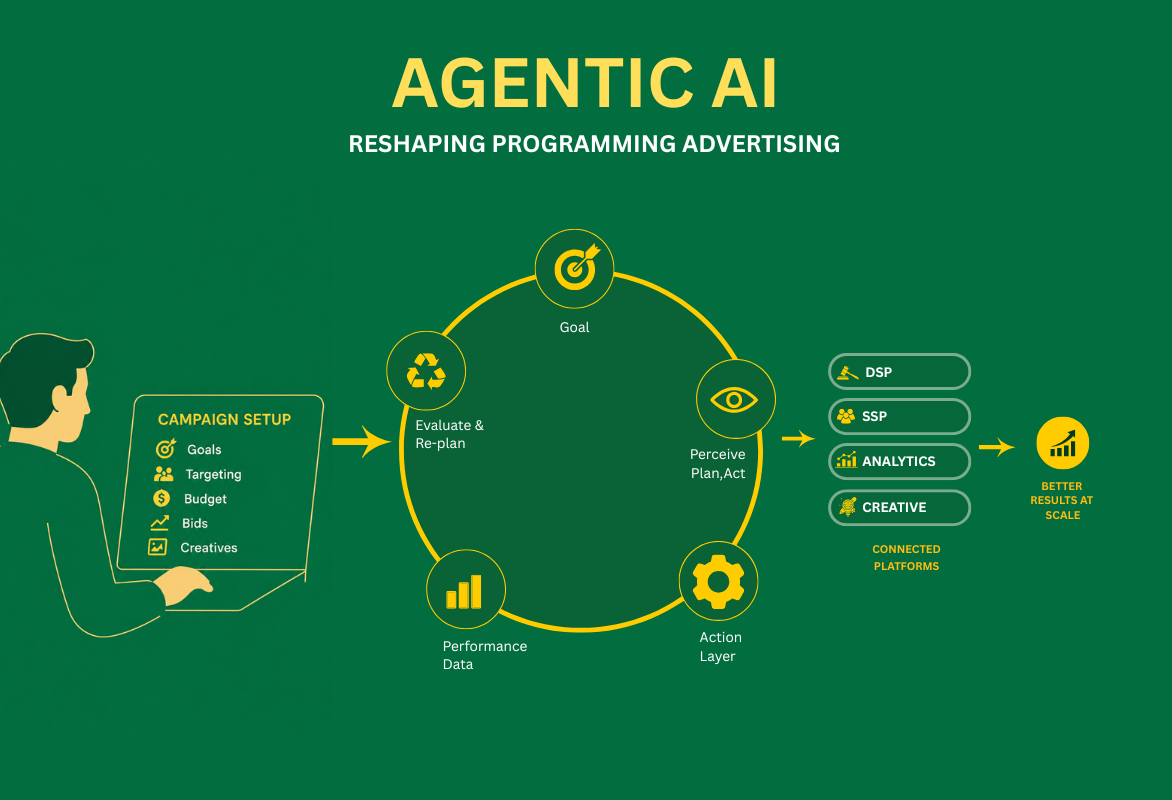
The next shift is already taking shape. Agentic AI, systems that set their own action plans to reach a defined goal, is beginning to move into the programmatic stack. This article breaks down how the current ecosystem works, what agentic AI actually changes about it, and what the real barriers to adoption look like.
A quick history of how we got here
Before ad tech platforms existed, media buying happened through manual negotiation. Advertisers and publishers agreed on placements in direct conversations, and ads were delivered by hand. Scale was essentially impossible.
Ad servers, introduced in the late 1990s, changed that. For the first time, a single system could decide which ad to show, to which user, on which publisher's page, automatically. That was the original promise of programmatic: use software and data to remove the human bottleneck from ad delivery.
How ad servers connect advertisers to publishers
The first wave of programmatic automation: a single ad server distributes creatives across multiple publisher sites automatically.
Over the following decade, demand-side platforms (DSPs), supply-side platforms (SSPs), and ad exchanges added more layers of automation. The crowning development was real-time bidding, the ability to evaluate a single impression and conduct an auction in under 100 milliseconds.
Real-time bidding (RTB)
How advertisers and publishers trade ad inventory via automated auctions lasting around 100 milliseconds.
Buy side
Advertiser
Agency / ATD
Ad server
Buy-side
Intermediaries
DSP
Demand
Exchange
Auction
SSP
Supply
Real-time bidding (RTB)
~100ms per auction
Ad server
Supply-side
Supply side
Publisher
Buy side
Intermediaries
Supply side
Agency / ATD
Ad server
Buy-side
DSP
Demand
Exchange
Auction
SSP
Supply
Real-time bidding (RTB)
~100ms per auction
Ad server
Supply-side
Each auction is initiated when a user loads a webpage. The winning bid determines which ad is shown, all within a single page load.
How campaign management works today?
Modern programmatic platforms are highly capable, but they still require humans to drive every strategic decision. Teams configure campaign parameters, monitor performance dashboards, and make manual adjustments when something drifts.
A typical campaign lifecycle runs through six repeating phases:
nullWhat advertisers configure today?
Every campaign contains a set of parameters that the platform uses to decide when and where to serve an ad. These inputs are entirely human-defined:
The anatomy of a digital ad campaign
Eight parameters every advertiser must configure before a campaign can run, all set manually today.
Goals and objectives
Audience targeting
Budget
Max. CPM / CPC / CPA
Frequency capping
Brand safety controls
Creative assets
Channels and placements
With today's programmatic systems, all eight parameters are set by the campaign team before launch. The platform executes within them, but doesn't change them.
Once a campaign is live, the platform optimises within those rails. Changing the rails, shifting budget, updating audience segments, pausing underperforming line items, is still a human job.
How campaign management works today?
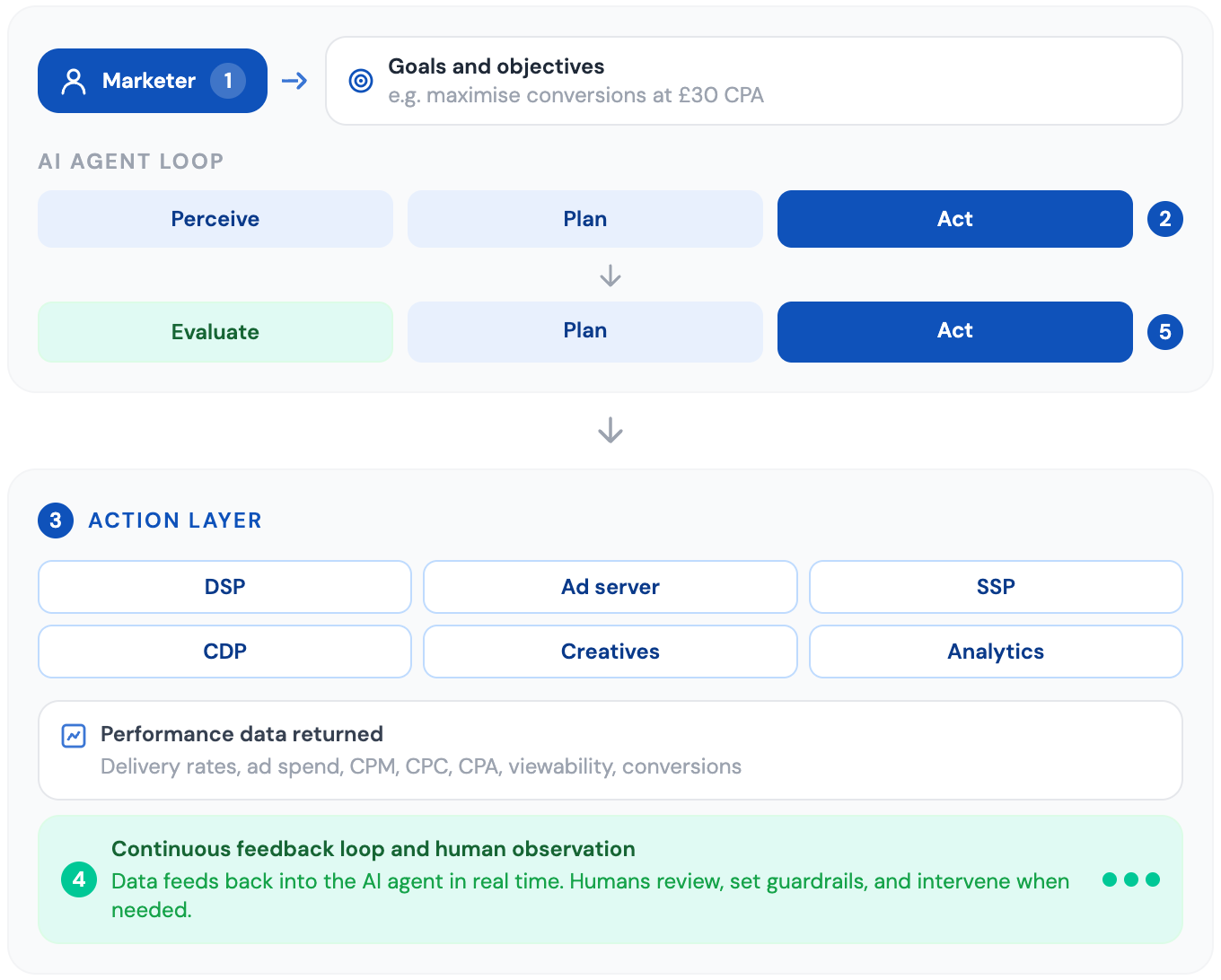
The key shift: today's systems follow rules. Agentic AI pursues outcomes, adjusting continuously without waiting for human review cycles.
Modern programmatic platforms are highly capable, but they still require humans to drive every strategic decision. Teams configure campaign parameters, monitor performance dashboards, and make manual adjustments when something drifts.
A typical campaign lifecycle runs through six repeating phases:
What agentic AI does not change?
It is worth being clear about what remains constant. Agentic systems do not replace strategic thinking, they remove the repetitive work that gets in the way of it.
Business strategy- Advertisers still define goals, audiences, budgets, and how success is measured. The AI operates inside those boundaries- it does not set them.
Brand judgment- Decisions involving brand voice, creative direction, and contextual suitability still require human assessment that performance data alone cannot capture.
Oversight- Teams will continue to review campaigns, audit AI decisions, and intervene when systems stray from expectations. The human role shifts from execution to supervision.
Will the industry actually adopt this?
The technology is directionally clear. The open question is how fast the surrounding infrastructure catches up.
Programmatic advertising has always relied on shared standards to function, OpenRTB, ads.txt, and VAST all required coordinated adoption before they delivered value. Agentic AI needs something similar: frameworks that allow AI agents from different vendors to communicate, share signals, and operate across platforms without creating security or transparency risks.
Early frameworks like the Ad Context Protocol (AdCP) and the IAB Tech Lab's Agentic RTB Framework are first steps in that direction. But as with every previous standard in this industry, adoption will follow the money.
The question will shift from "Should we invest in this?" to "What is our return if we do not?" Platforms and agencies that build familiarity with agent-based workflows now will be better positioned to move quickly when that inflection point arrives.
Streamlyner covers automation, AI, and data strategy for modern advertising teams. Visit us at Streamlyner.com